- Produkter
- Centrifuger
Centrifuger
Centrifuger
Buch & Holm har arbetat med centrifuger sedan 1935. Vi vet vad som behövs i samband med rådgivning, support och service av denna typ av utrustning.
Vårt program täcker allt från de minsta bordscentrifugerna till golvcentrifuger med en kapacitet på upp till 12 liter. Vakuumcentrifuger, mikrocentrifuger, minicentrifuger, universalcentrifuger samt high-speed-centrifuger med en hastighet upp till 30 000 rpm som motsvarar 70,121 x g.
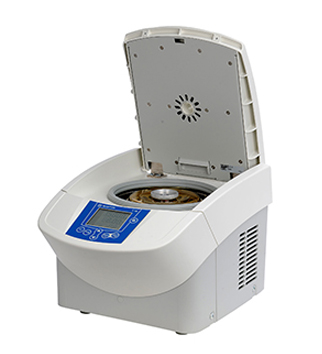
What centrifuge should I choose?
- Capacity and throughput: Assess how many samples you need to run per batch and how often. Swing-out rotors provide flexible capacity for many tubes and bottles, while angle rotors typically provide higher g-forces and shorter run times. Consider future needs, so you don't outgrow the solution.
- RCF (× g) vs. RPM (rpm): It is RCF that drives the separation. Most protocols specify × g; choose a centrifuge/rotor that reaches the required RCF at reasonable RPM. Remember that RCF depends on the radius of the rotor – two centrifuges with The same RPM can deliver different × g.
- Rotor type: Swing-out for planar separation, large volumes and gentle pellets/layers; angle rotor for high g-force and fast spin-downs; special rotors for plates, hematocrit, filtration or biosafe handling. Choose lids/inserts that fit your containers exactly.
- Temperature control: Refrigerated models stabilize temperature for long runs, volatile solvents, or heat-sensitive samples. Combined cooling/heating can accelerate protocols with controlled temperature profile, while uncooled Models are ideal for quick, routine tasks.
- Safety and biosecurity: Consider aerosol-tight lids, imbalance detection, automatic lock, and certified biosafety rotors in clinical work. Proper accessories reduce the risk of spillage and contamination and increase operator safety.
- Ergonomics and noise: Noise level, door height, loading height and rotor handling affect daily comfort. Auxiliary equipment such as trolleys and insert racks improve workflow and space utilization – especially in small laboratories.
- Space and infrastructure: Check external dimensions, weight, ventilation and power requirements. Floor models provide large capacity without taking up desk space, while benchtop models can be integrated close to the workstation for shorter turnarounds.
- Compliance and documentation: Need validation, logging, user profiles or audit trails? Choose operating systems and firmware that support SOPs, locked applications, service log, and optionally network integration.
- Service and total economy: Look at available rotors/adapters, price of wear parts (gaskets, lids, filters), service intervals and response time. A well-thought-out service plan and modular accessories reduce downtime and total cost of ownership.